Overview
Boston, MA
April 2004
Payments Innovation in SE Asia:
Through the Looking Glass
NEW RESEARCH REPORT BY MERCATOR ADVISORY GROUP
The long standing perception is that the SE Asia card industry is light years ahead of the US in terms of payment technologies. But... is this really the case? Is the grass actually greener or is it that the looking glass through which we view this region is green tinted.
This, the latest report by Mercator Advisory Group, takes a closer look at the SE Asia region and investigates payment initiatives that are widely considered technologically advanced. Nick Holland, Director of the Emerging Technologies Advisory Service for Mercator Advisory Group and co-author of the report has a different take on the traditional view:
"Why they have cell phones that double as contactless electronic wallets and why we still have magnetic stripe cards isn't purely down to technological advancement but more to do with historic, regional and cultural differences. We still swipe our cards at checkout because we have a system of real-time fraud mitigation that works. And since it works, we have had no reason to fix it. Due to the extremely high cost of telecommunications in the region, Japan and other innovators had to take an alternative evolutionary path to compensate for this. Not better, not technologically beyond our reach, just different..."
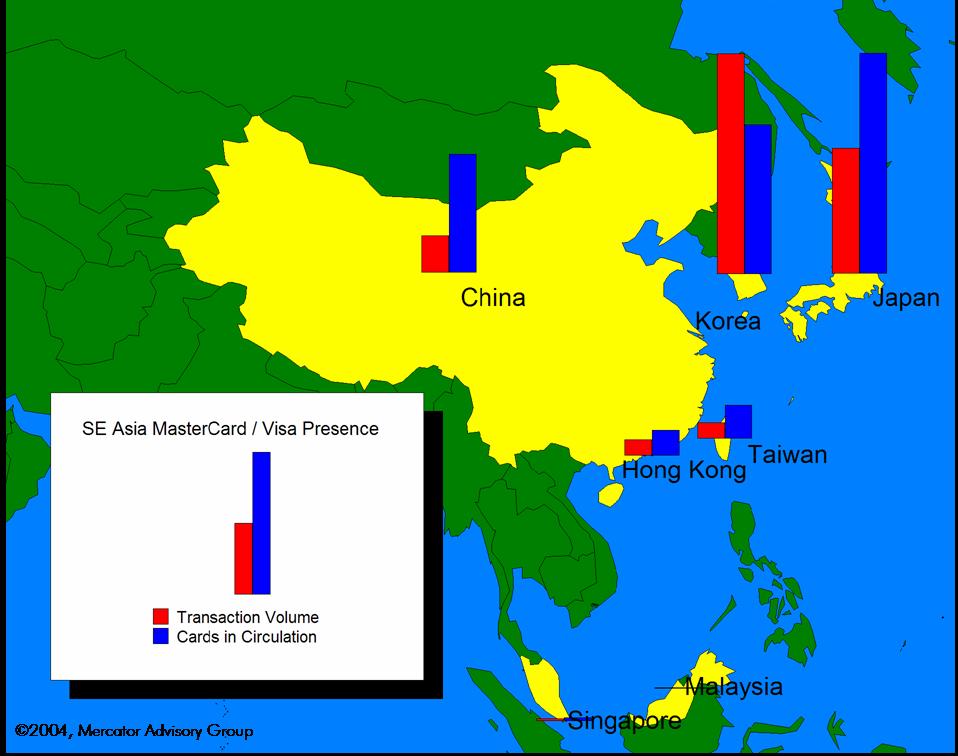
Visa and MasterCard Presence in the SE Asia Region (2003),
One of nine exhibits included in this report
The report analyzes the hub of innovation stemming from the Sony FeliCa card and its affiliated brand names: Suica, Edy, eLIO and Octopus, NTT DoCoMo's iMode service, JCB and Kookmin Bank and contemplates the ways in which these idesa will move to US shores.
Holland sees a continued cross-pollination of ideas from east to west and vice versa, but core differences will remain irresolvable:
"The MasterCard PayPass launch this year has to be in part attributed to the success of SE Asian contactless initiatives such as Edy and Octopus proving the business case for contactless smartcards. Conversely, the shift in acceptance of revolving credit in SE Asia is a learning curve that the region is slowly climbing. Its not just about the technology, its about what it can do for the user, the merchants and all parties involved..."
The report contains 27 pages 9 exhibits.
Members of Mercator Advisory Group have access to these reports as well as the upcoming research for the year ahead, presentations, analyst access and other membership benefits. Please visit us online at www.mercatoradvisorygroup.com.
For more information call Mercator Advisory Group's main line: 508-845-5400 or send email to [email protected].
Make informed decisions in a digital financial world