Overview
In a new research report, Dodd-Frank and Corporate Banking: Still Murky After All These Years, Mercator Advisory Group examines the legislation to understand how it has affected corporate banking entities, and as such, what might change should various possible adjustments be made during the current administration.
"It is difficult to quantify the benefits of the Dodd-Frank Act since it was intended to improve safety of the banking industry and fairness toward consumers in the abstract. The sweeping piece of legislation as structured left many unanswered questions about its potential impact, so we decided to take a look now and see what might be evident, commented Steve Murphy, Director of Mercator Advisory Group’s Commercial and Enterprise Payments Advisory Service, author of the report. “As one might expect, for bank holding companies, compliance costs have become a larger part of business unit operating expenses. There is also evidence of unbalanced commercial lending constraints and pressured revenue margins, which banks have to manage. But a more insidious, longer-term impact may come from the underlying structure of the legislation, which leaves rules changes as a contentious political playground.”
This report is 19 pages long and has 6 exhibits.
Companies mentioned in this report include: ACL, Appian, CetoLogic, Convergepoint, Datamatics, Earnix, Finastra, FIS, Jack Henry, Moody’s Analytics, Nomis, Novantas, Openlink, Oracle, RSA Archer, SunTec, THC Network, Thomson Reuters, Wolters Kluwer, and Zafin.
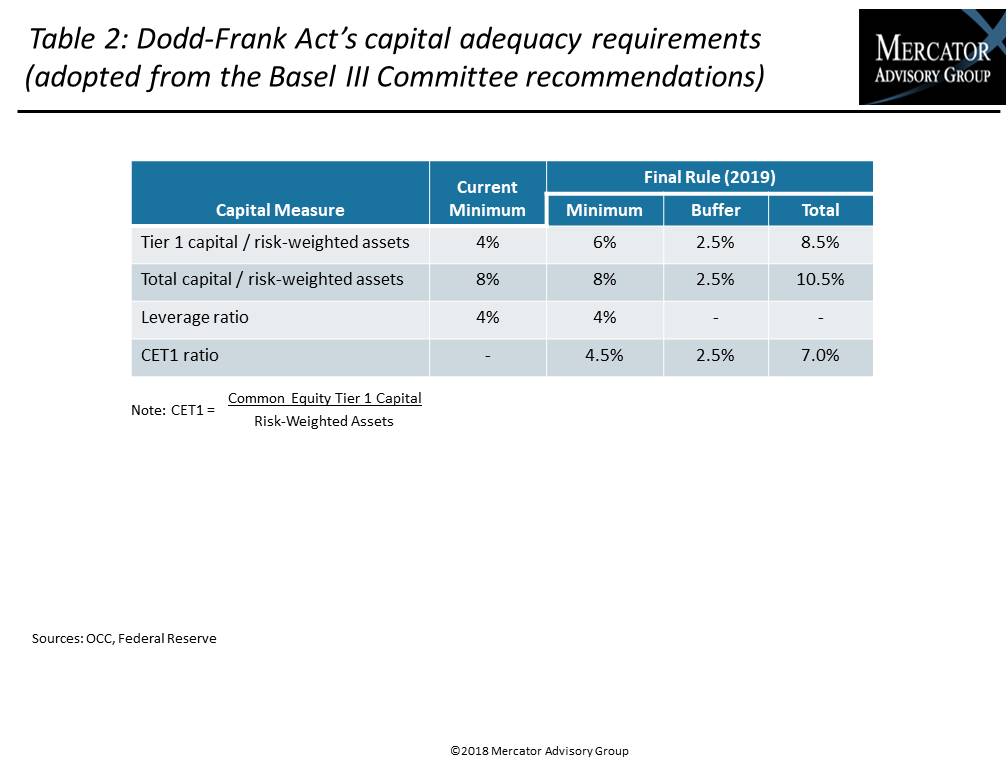
One of the exhibits included in this report:
- A detailed review of Dodd-Frank sections that are most directly related to corporate banking businesses
- Analysis of the incremental compliance costs, as well as possible benefits
- A detailed comparison of two scenarios showing the impact of the liquidity coverage ratio on balance sheet flexibility
- Discussion of the proposed changes to the law and most likely outcomes
- Decisions that banks can make to best manage their portfolios going forward
Make informed decisions in a digital financial world